
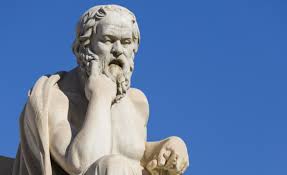
Art of Discussion

Gil, a screenwriter and aspiring novelist vacationing in Paris with his fiancée, Inez, runs into one of her old friends Carol and her husband Paul, a history professor. The four decide to go to Versailles together and take a tour of the grounds. The tour begins, and the guide points out various intriguing facts about each piece that the group comes across. However, after the first few pieces, Paul begins to spout out his own impressive spread of facts about the pieces, often interrupting or completely disregarding the tour guide. He argued over anything from a piece’s exact completion date to who made it or what technique they used. After a few more minutes, Paul has advanced to arguing with and discrediting the tour guide on each stop that the group makes. As tension rises within the group, Gil’s face is obviously distraught with annoyance and a little sympathy for the tour guide, who also seems very uncomfortable with the situation she has found herself in. All the while, Carol and Inez are fascinated and memorized by Paul’s impressive scholarly temperament.

Many of us have most likely found ourselves in a discussion where we felt like we knew enough about a topic that we felt superior to or more knowledgeable than others. In these discussions, some of us probably sounded knowledgeable, yet winsome and thoughtful in the way we rebutted. However, others of us probably sounded like an arrogant intellectual, or worse and arrogant pseudo-intellectual. Whether we know everything there is to know about something, or know very little about it, it is important to guard the way we sound to others as we voice our own opinions. No matter how much we know about a topic, it can easily be discredited or ignored because of a presumptuous or vain tone. There are three ways that we often come across in these situations: The Erudite, the Pontificator and the Pedantic. If it isn’t already evident which one is desirable in conversation, it will be soon.

The Erudite is very knowledgeable, learned and scholarly. Although an erudite is sometimes thought of as someone who is snobby and stuck up or arrogant, they do not have to be. For example, in the book Divergent, by Veronica Roth the class called the Erudite, who keep order within the city and create all the new technology, often were condescending and arrogant towards the other classes. However, Caleb, an Erudite and brother to the protagonist Beatrice, was kind and selfless. Even though he struggled to see through the corruption of the Erudite class, he never conformed to their condescending ways. The Erudite has gained his/her vast knowledge and deep understanding of the topic from years or research and study. This person doesn’t just know the first google search page about that topic, but much of the information hidden within textbooks or journal articles; something that required deliberate and thoughtful research. An example of an Erudite in Gil’s situation would perhaps be a Parisian Art History professor at Oxford or a Parisian History professor from Cambridge. Both hypothetical people would be considered an Erudite because to be a professor at one of those Universities one must be well versed and accomplished in a very specific field. Moreover, they teach subjects that are very directly related to the topic at hand: artwork at Versailles. This does not necessarily rule out the option that Paul is an Erudite, but we do not have enough information about him to know for sure.

The Pontificator very openly expresses their opinions in a pompous or dogmatic way, regardless of the veracity of their claims. This personality trait we can pin on Paul, because he very openly expressed his beliefs about certain pieces. We have no way of knowing whether he is correct or not, but in this case that does not matter. Because of Gil and the tour guide’s expressions, it is obvious that Paul was dogmatic in his approach to the pieces of art. Two common synonyms for the verb pontificate are declaim and lecture. In conversation, we often feel a need to declaim or attack the other party’s points. However, it is perfectly acceptable-and much more pleasant-to respectfully disagree when necessary. In addition, it is common that one might begin to lecture the other party, spitting out fact after fact, trying to show them all the information that we know to shut them down before they even begin. This method is not only ineffective, because by shutting the other person down we not only shut their mouth but also their ears, but also because it is extremely annoying and arrogant.

Finally, the Pedantic is excessively concerned with minor details or with displaying academic learning. In certain cases, minor details are very important; but many times, someone who does not really know what they are talking about will focus in on these details to mask their lack of knowledge. There are plenty of circumstances where a Pedantic does know what he/she is talking about but finds themselves unnecessarily lost in the details. It is unclear whether Paul is excessively concerned with details, because we do not know exactly what he said. He showed signs of it in certain art pieces arguing over the exact date of its completion or the exact type of brush stroke used on a certain piece; but he mostly focused on showing off his knowledge of everything. However, because he was so focused on showing off his academic prowess, he does fall into the pedantic category. As some would say, he loved the sound of his own voice, and so did Carol and Inez.

These three characters are very similar in that they evolve around information in conversation, however it is the differences that are key to effectively converse with others. The Erudite is inadvertently a good person to have in a conversation. They provide plentiful knowledge and experience, which maintains the validity of the argument. However, if the Erudite finds themself being a pontificator or a pedant, they can ruin a discussion. It is crucial to know where the line between these three words is so that one can be careful not to cross into ignorance.

The Nutgraf

During the summer of 1889 in New York city, Charles H. Dow started a small publication, whose aim was to bring news on business and finance to the average person. Although the Wall Street Journal’s first post was in 1889, it really found its footing during the Great Depression, following the crash of the stock market, because finance became suddenly  relevant and important to everyone in the 1930’s.

According to Encyclopedia Britannica, “The journal rarely ventured beyond business and economic news” because that was not what Dow had in mind when he created his journal. Every so often, The Journal would feature an article on another topic, such as war, which became increasingly popular during WWII. However, by the 1960’s, the journal regularly featured two articles on subjects other than business and finance. Now, in the 21st century, subscribers regularly look to the Wall Street journal for all kinds of stories from economics, to justice and politics, to medicine and research. However, the Wall Street Journal is only one of hundreds of other journals. How did this single journal find itself head and neck above so many others?

A journal at its core is a source of reliable relevant information on any number of topics. There are medical journals, art journals, business journals and many others; but there is a unique aspect of the Wall Street Journal that placed it in its own bracket. In 1941, Barney Kilgore, managing editor of the Wall Street Journal, declared that “It doesn’t have to happen today to be news. If the date is essential, use the exact date.” This did not simply mean that journalists couldn’t use the word today or yesterday in there leads, it meant so much more. It was the introduction of the nutgraf to the world, a method of journalism that would revolutionize the way we write news articles. The nutgraf is a method first used by the Wall Street Journal that puts more power in the reader’s hands. A nutgraf summarizes the main idea of the article without giving too much away. It allows the reader to decide from the beginning whether he wants to read the story or not. If not, he comes away knowing the general point of the article, if he does, then he already knows what the article is about, allowing him to track along with the body much more easily.

This method delivers a promise. It sets up the thesis of the story, promising to explain it later. It puts explanation over information and understanding over knowledge. However, the most important piece of this method is how compact it is. It’s like a nut from a tree. One oak tree nut is no more than 4 centimeters wide, however it produces some of the most beautiful trees standing sometimes up to 40 meters tall. In the same way, a nutgraf is a short, compact paragraph or two – depending on the length and depth of the article as a whole – that holds many paragraphs worth of explanation and understanding within it. For example, in an article about clean energy, the nutgraf would do three things. It would connect the lead to the rest of the article, it would very briefly summarize the topic of clean energy and its relevance to today’s society and it would clearly state the thesis of the article, without being too argumentative. An article can have a thesis, or a standpoint, without arguing anything. If it were about clean energy, it might say: “Clean energy came onto the electrical scene in the late 20th century bringing with it a Pandora’s box of both new unforeseen benefits and issues. Nevertheless, clean energy is one of the 21st century’s hot topics.” This thesis statement has a clear point, clean energy is a prominent piece of 21st century society, but it does not argue whether it is good or bad, whether it should be researched or not. It simply states the purpose of the article. For the last eight decades, the Wall Street Journal, among many others, has used the nutgraf to create engaging, relevant and significant articles that have both informed and given the gift of understanding to millions of people.

The Wall Street Journal was only the beginning of this new age of journalism. When they began utilizing the nutgraf, thousands of other journalists followed the trend as they saw the success the Wall Street Journal had with their method. Now, with the popularity of reading online, tens of thousands of websites, online journals and online newspapers use this method or a similar version of it to entice the reader, to give the reader a good experience and most importantly to help the reader understand.


September 2018

This date, September 1, 2018, marked the start of a journey, a hero’s journey-of sorts-one that will who’s fruit will remain far beyond its years…


I guess I really should have said “far beyond its year” because I am speaking strictly of my gap year, which as stated in the name, entails only one year off from school; an opportunity to experience a hint of adult life, including all the enjoyable and less enjoyable moments. Many different projects of sorts kicked off September 1, including my first official gap-year-great-books-program book called The Hero With A Thousand Faces, by Joseph Campbell, my internship with my father, my regular blogging, my new workout program, basketball training and a few other less glamorous tasks. These mostly consist of learning and growing in areas of cleanliness and organization, whether at home, at work or elsewhere.

I will start with the fun stuff: basketball and working out. Throughout the summer, I had been going to a weekly semi-organized pick up basketball league just to continue to stay proficient and to have fun. It for a while was each Wednesday from 8:00-9:30 p.m., however after a month or two in moved to every Monday at the same time. This schedule change actually ended up being far more beneficial than I realized at the time. Soon after the start or school, Wednesday youth group would also start back up, which meant I had a more pressing responsibility as a leader each Wednesday night during the same time as basketball. Now, that would not be an issue. Moreover, the same coach who organized this pick-up recommended that if I wanted to start individualized training again, he would recommend I come Monday evenings at 7:00 p.m. At the start of September 2018, I did in fact resume training, which meant that I could consolidate my scheduled basketball time into two and a half hours each Monday night, instead or one hour Monday and one and a half on Wednesday. So I now do this every Monday from 7:00-9:30 p.m. I also try to practice as much as I have time for during the rest of the week. Perhaps the most exciting things for me that I begun this month was my new workout regime. Built upon years of lifting experience from my school strength trainer, various workout videos/routines and a lot of research I have created a workout routine that in the past month has produced results head and neck above anything else that I have ever done. In just 5 short weeks, I have gain 18 pounds, consisting of muscle, water weigh and most importantly very, very low amounts of fat (which is very hard when bulking in a traditional way). I am very excited to see where my body goes in the next few months as I strive to get in basketball-ready shape. I have also been doing a combination of long and short distance running to stay in good cardiovascular shape as well as to stay lean. Finally, once I reach my goal of 215 lbs, I plan on going on a leaning process, which I have already started researching, in order to drop a little fat, keep muscle and most importantly get a very high cardio proficiency as well as work on my vertical, which I am also happy to say has not gone down at all despite the 18 pounds that I have gained. I cannot wait to keep going with this process.

Now, moving onto less physical and more mental activities, I have begun a few things to maintain/improve my mental ability for school next fall. I started our homemade Great Books program intent upon building my reading speed and quality in preparation for whichever college I attend (especially if I choose Biola, because I would attend their honors program which is built around reading a book a week). I haven’t quite reached a book per week, but I am learning to enjoy reading. This month I read, as I mentioned before, The Hero With A Thousand Faces, by Joseph Campbell. I wont go into too much detail because I will soon be posting specifically about it and what I have learned from it. I have also started posting on this site more often and learning how to write alaWSJ (meaning like a Wall Street Journal article) and in general how to write in a less argumentative way. This post is not written in that way because it is just an update, but hopefully my growth will be evident throughout my next posts. I have also nearly finished writing a WSJ-esc article about the relationship between an Erudite, a Pontificator and a Pedantic, which I will post as soon as it is finished.

Finally, I have begun two internships, one with my father, which includes attending some of his meetings as well as the occasional lesson on Marketing, business, content management, web design or any other related topic. The second internship is with State Representative Jason Isaac at the Capitol. I work in his office responding to letters, emails and phone calls. I read these, type them into a Content Management System (CMS) for others in the office to view as well as to keep a record of everyone who contacts the office. I also run errands and do whatever else is asked of me.

Each of these opportunities listed above have given me the tools to grow in many different areas and ultimately have an effective and beneficial gap year. I strive to improve myself in mind, body, and spirit and feel that I have effectively begun to do so. Using my workout routine and basketball schedule I have improved my body, with my blogging, reading, interning and working at the YMCA and Cow Tipping Creamery I have improved my mind and at Church and leading youth group I have improved myself spiritually. I know that these experiences will last me far beyond the days, weeks and months of my gap year into college, into early adulthood and into the rest of my life. I am very grateful for each and everyone of the people that made these things possible.